Meta Pixel vs Conversions API (CAPI)
For years, most advertisers relied on the Meta Pixel to understand what happened after someone clicked an ad. You installed a small snippet of code on your site, and Meta could see page views, leads, and purchases inside the browser. It worked — until the internet changed.
Privacy updates from Apple, browser-level tracking prevention, and widespread ad blockers have significantly reduced how much data browser-based tracking can reliably collect. As a result, many advertisers now see gaps in reporting, delayed attribution, or missing conversions — even when campaigns are clearly driving results.
This is where Meta’s Conversions API (CAPI) comes in.
Instead of relying solely on the user’s browser, CAPI allows conversion events to be sent directly from your server to Meta. This server-side approach makes tracking more resilient to privacy restrictions, improves data accuracy, and gives Meta’s delivery system more consistent signals to optimize campaigns.
That doesn’t mean the Meta Pixel is obsolete — far from it. Pixel and CAPI are designed to work together, each serving a different role in modern ad measurement.
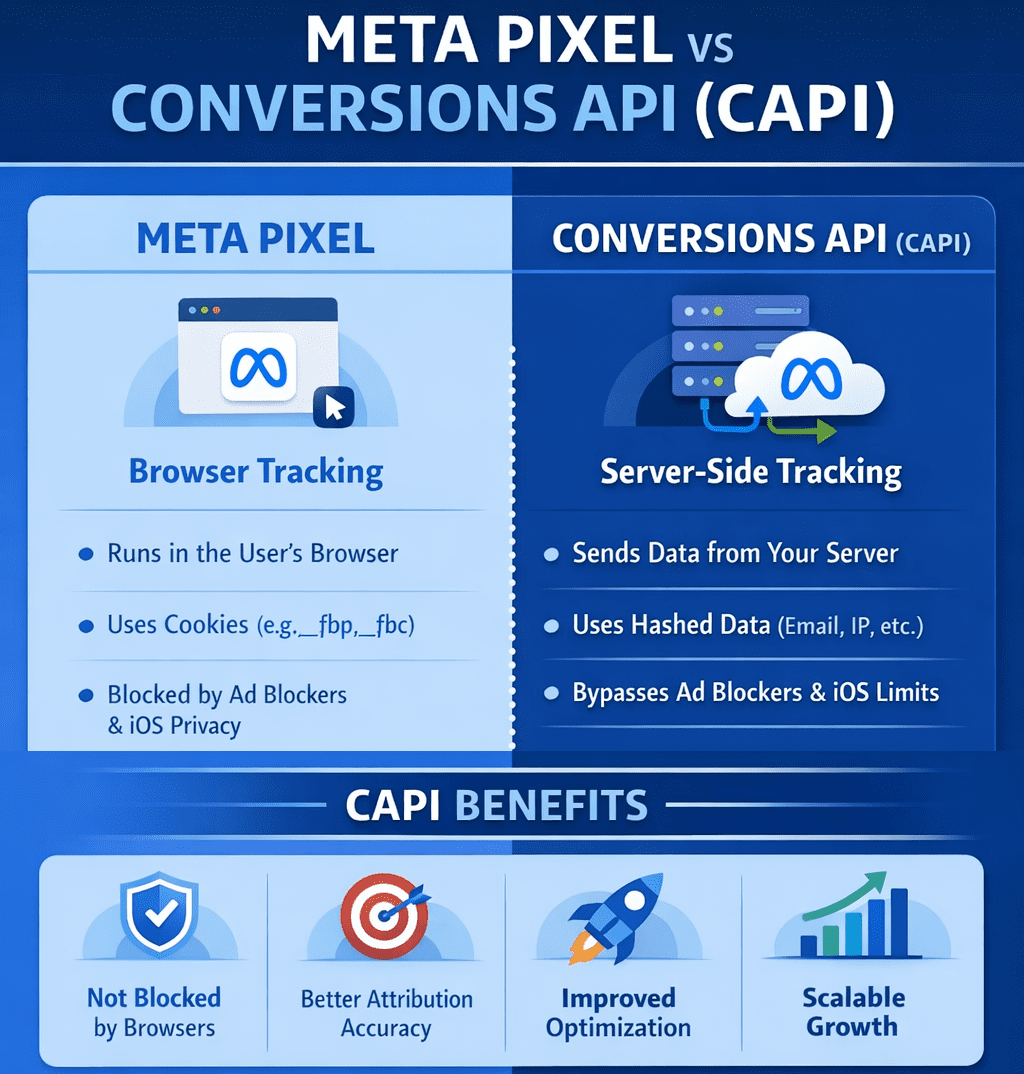
What is the Meta Pixel?
The Meta Pixel is a browser-based JavaScript tracker that fires events when a user loads a page or takes an action.
How it works
-
Runs in the user’s browser
-
Uses cookies (
_fbp,_fbc) -
Sends events like
PageView,ViewContent,AddToCart,Purchase
Strengths
-
Very easy to install
-
Real-time feedback in Events Manager
-
Captures on-site behavior like scroll depth, clicks, watch time
Limitations (big ones)
-
Blocked by:
-
Ad blockers
-
iOS privacy rules (ITP)
-
Browser tracking prevention
-
-
Loses attribution when cookies expire or are stripped
-
Increasingly under-reports conversions
Best use
Front-end signal discovery (what users do on the page)
What is Conversions API (CAPI)?
CAPI is server-side tracking. Instead of relying on the browser, your server sends events directly to Meta.
If you run a CRM, Shopify, or any big branded platforms chances are CAPI is already part of the system, you would just need to make sure it’s enabled and set up properly.
If you run a more basic website like a WordPress site, or something that doesn’t have built in support, then you would need to either build your own backend server (you can literally do this very easily in DigitalOcean), run it locally (not recommended), or pay to use a service which does all of it for you with a guarantee of ad attribution performance and ad savings. If you’re interested in that last bit, and if you spend a hefty sum per month on Meta ads, you might want to consider looking deeper into this.
How it works
-
Events are sent from:
-
Your backend
-
A tag manager server
-
A custom endpoint
-
-
Can include hashed identifiers:
-
Email
-
Phone
-
IP
-
User agent
-
fbp/fbc (when available)
-
Strengths
-
Not blocked by browsers or ad blockers
-
More stable attribution
-
Better match quality for Meta’s AI
-
Required for advanced attribution and scaling
Limitations
-
More complex to implement
-
Needs proper event deduplication
-
Requires backend or server tooling
Best use
Reliable conversion truth for optimization and reporting
Pixel vs CAPI (quick comparison)
| Area | Meta Pixel | CAPI |
|---|---|---|
| Runs in | Browser | Server |
| Blockable | Yes | No |
| iOS impact | High | Minimal |
| Setup | Easy | Technical |
| Attribution accuracy | Medium → Low | High |
| Required for scale | ❌ | ✅ |
The correct setup (this is the key part)
You should NOT choose Pixel or CAPI.
You should run BOTH.
Why?
-
Pixel captures behavioral signals (what users do)
-
CAPI guarantees conversion delivery
-
Meta deduplicates events using
event_id
Correct flow
-
Pixel fires event in browser
-
Server sends the same event via CAPI
-
Meta deduplicates
-
AI gets cleaner, richer data
-
Delivery and optimization improve
This is exactly how Meta expects serious advertisers to operate in 2026.
When Pixel alone is “good enough”
-
Small spend (<$50/day)
-
Lead gen without backend control
-
Early testing / MVP funnels
Even here, you’re flying partially blind.
When CAPI becomes mandatory
-
Scaling spend
-
iOS-heavy audiences
-
Ecommerce
-
Video + engagement optimization
-
Advanced attribution (multi-touch, offline, CRM)
If you’re doing any serious optimization, Pixel-only is no longer sufficient.
How Meta’s AI actually uses this data
Meta’s delivery system doesn’t just look at conversions — it looks at:
-
Event frequency
-
Signal consistency
-
Identity match quality
-
Engagement depth (watch time, dwell, repeats)
CAPI improves confidence, not just counts.
That’s why campaigns often stabilize after CAPI is implemented — even when reported numbers don’t jump dramatically.
Bottom line
-
Meta Pixel = visibility + behavioral signals
-
CAPI = reliability + optimization fuel
-
Together = modern, scalable tracking
Want it just done for you?
Book a demo with Hyros where they handle everything
Download Your FREE
Dev Stack Starter Guide

Build, automate, and launch faster—see the automation stack developers and agencies are switching to.
- ✅ API Templates & Code Snippets
- ✅ Done-for-You Automation Workflows
- ✅ Step-by-Step Funnel & CRM Guide
- ✅ Free for Developers, Freelancers, & SaaS Builders