Heroku in Maintenance Mode – Why We’re Not Building New Projects on Heroku (And What We’re Choosing Instead)
Heroku is not shutting down.
It remains supported, secure, and operational. Existing applications continue to run without disruption.
However, Salesforce has shifted Heroku into a sustaining engineering model. That shift changes how we evaluate it for new infrastructure decisions.
This article explains:
-
What Heroku’s maintenance mode really means
-
Whether it’s safe to build new projects on Heroku
-
The long-term risks developers should consider
-
Modern Heroku alternatives in 2026
-
A practical decision framework
If you’re deciding whether to build on Heroku in 2026, this guide will help.
What Changed With Heroku?
Salesforce repositioned Heroku into a maintenance-focused strategy:
-
Security updates continue
-
Stability is maintained
-
Compliance support remains
-
Critical bug fixes continue
-
Major feature innovation has slowed
-
Enterprise growth investment has cooled
This is not a shutdown.
But it is a trajectory change.
What “Maintenance Mode” Means for Developers
A platform in sustaining engineering typically focuses on:
| Area | Expected Status |
|---|---|
| Security patches | Continue |
| Stack updates (Ubuntu LTS) | Continue |
| Runtime support (Node, Ruby, etc.) | Continue, but conservatively |
| Major new features | Limited |
| New compute types (GPU/ARM) | Unlikely |
| Ecosystem expansion | Slower |
| Marketplace innovation | Gradual decline risk |
Heroku is now optimized for stability, not expansion.
That distinction matters for long-term architecture planning.
Is Heroku Safe to Use in 2026?
Yes — for existing applications.
The more important question is:
Should you build new projects on Heroku?
That depends on your goals.
Heroku: Strengths and Limitations
Strengths
-
Extremely simple deployment workflow
-
Mature operational stability
-
Strong historical documentation
-
Good fit for small SaaS and internal tools
-
Minimal DevOps overhead
Limitations
-
Slower platform innovation
-
Limited roadmap visibility
-
Potential ecosystem contraction over time
-
Less differentiation in a container-native world
-
Higher lock-in via add-ons and workflows
Heroku vs Modern Alternatives (Comparison)
Here’s a high-level comparison for new builds:
| Feature / Criteria | Heroku | Render | Fly.io | Railway | DigitalOcean App Platform | DigitalOcean (Droplets + Docker) |
|---|---|---|---|---|---|---|
| Platform Status | Maintenance mode | Actively expanding | Actively expanding | Actively expanding | Actively expanding | Fully developer-controlled |
| Deployment Model | Git-based + buildpacks | Git + Docker | Docker-first | Git + Docker | Git + Docker | Docker / manual |
| Container Native | Partial | Yes | Yes | Yes | Yes | Yes |
| Roadmap Velocity | Low | Medium–High | High | Medium | Medium–High | Depends on you |
| GPU Support | No | Limited | Emerging edge focus | No | Limited | Yes (via DO GPU droplets) |
| Edge / Multi-Region | Limited | Moderate | Strong global edge | Limited | Moderate | Manual setup |
| Managed Databases | Yes | Yes | Yes | Yes | Yes | Yes (separate product) |
| Add-On Marketplace | Mature but static | Growing | Smaller | Growing | Smaller | External services |
| Vendor Lock-In Risk | Moderate–High | Moderate | Moderate | Moderate | Moderate | Low |
| Infra Control | Low | Moderate | Moderate | Moderate | Moderate | High |
| DevOps Required | Very Low | Low | Moderate | Low | Low | Moderate–High |
| Long-Term Scalability | Stable plateau | Growing | Growing | Growing | Growing | Fully scalable (manual) |
| Best For | Legacy apps, simple SaaS | Modern SaaS | Edge apps, global scale | Fast MVP | Simpler PaaS w/ cloud flexibility | Full control, cost efficiency |
Key Insight:
Heroku remains stable. Most alternatives are still investing and expanding.
The Lock-In Factor
One of the most overlooked considerations is migration difficulty.
Heroku encourages platform-native workflows:
-
Buildpacks
-
Release phase
-
Add-ons marketplace
-
Platform-managed config vars
-
Review apps and pipelines
These accelerate early development.
They can increase migration friction later.
Lock-In Spectrum
| Lock-In Level | Example Setup | Migration Difficulty |
|---|---|---|
| Low | Dockerized app + external DB | Low |
| Medium | Heroku Postgres + buildpacks | Moderate |
| High | Heavy add-ons + pipelines + release workflows | High |
Before committing to Heroku for a new system, ask:
If we needed to migrate in 24 months, how painful would this be?
The Bigger Industry Context
When Heroku became dominant:
-
Containers were not universal
-
CI/CD tooling was immature
-
Infrastructure automation was niche
-
Platform engineering was rare
In 2026:
-
Docker is standard
-
Managed container platforms are abundant
-
Infrastructure as Code is expected
-
Portability is a priority
Heroku’s original abstraction advantage has narrowed.
It is no longer uniquely differentiated.
Our Decision Framework
We use a simple infrastructure evaluation checklist.
We Avoid Platforms That:
-
Are in maintenance mode
-
Have limited roadmap transparency
-
Show declining ecosystem momentum
-
Introduce hard-to-reverse architectural lock-in
We Prefer Platforms That:
-
Are container-native
-
Actively expanding features
-
Support portability
-
Align with cloud-native standards
Decision Matrix: Should You Use Heroku in 2026?
| Scenario | Recommendation |
|---|---|
| Existing stable app | Stay |
| Small MVP / side project | Acceptable |
| Funded startup planning 3–5 years | Consider alternatives |
| Compliance-heavy enterprise system | Consider alternatives |
| Long-term scalable SaaS | Use growth-aligned platform |
| Need GPU / edge / infra flexibility | Choose alternative |
What We’re Choosing Instead
We are prioritizing platforms that are:
-
Container-first
-
Actively developed
-
Portable
-
Transparent about roadmap direction
Depending on project complexity, that includes:
-
Modern managed PaaS platforms
-
Cloud-native container services
-
Kubernetes for advanced workloads
-
Docker + VPS for controlled deployments
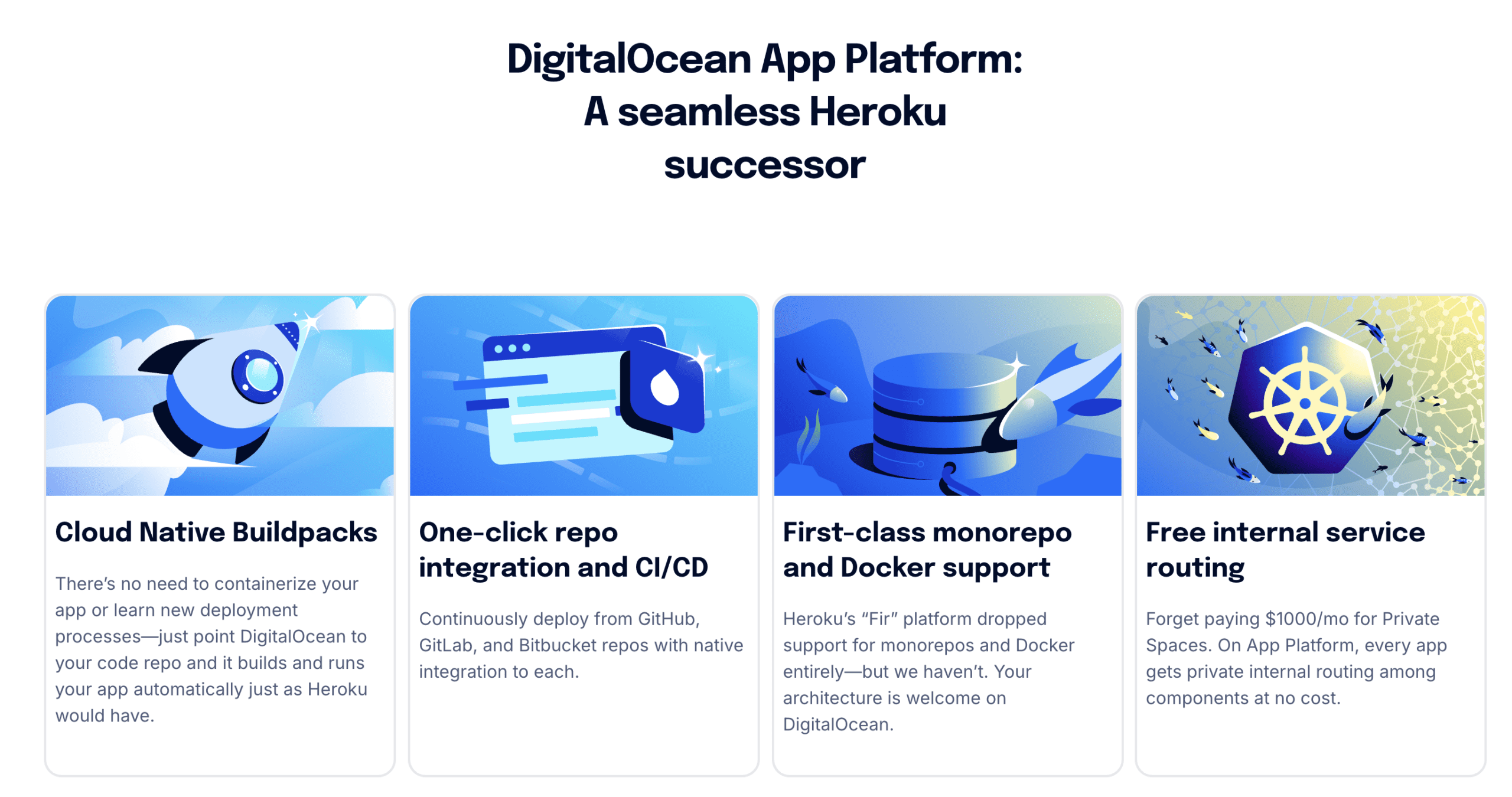
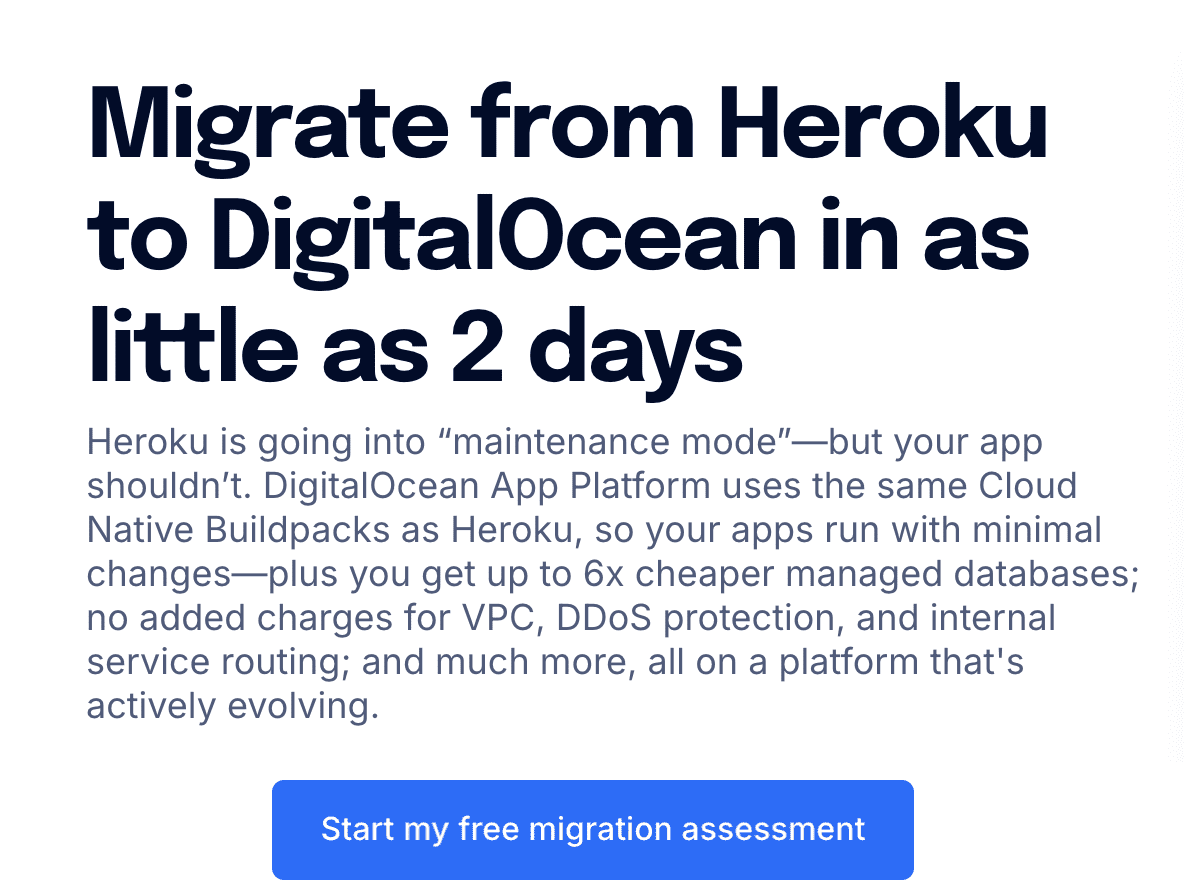
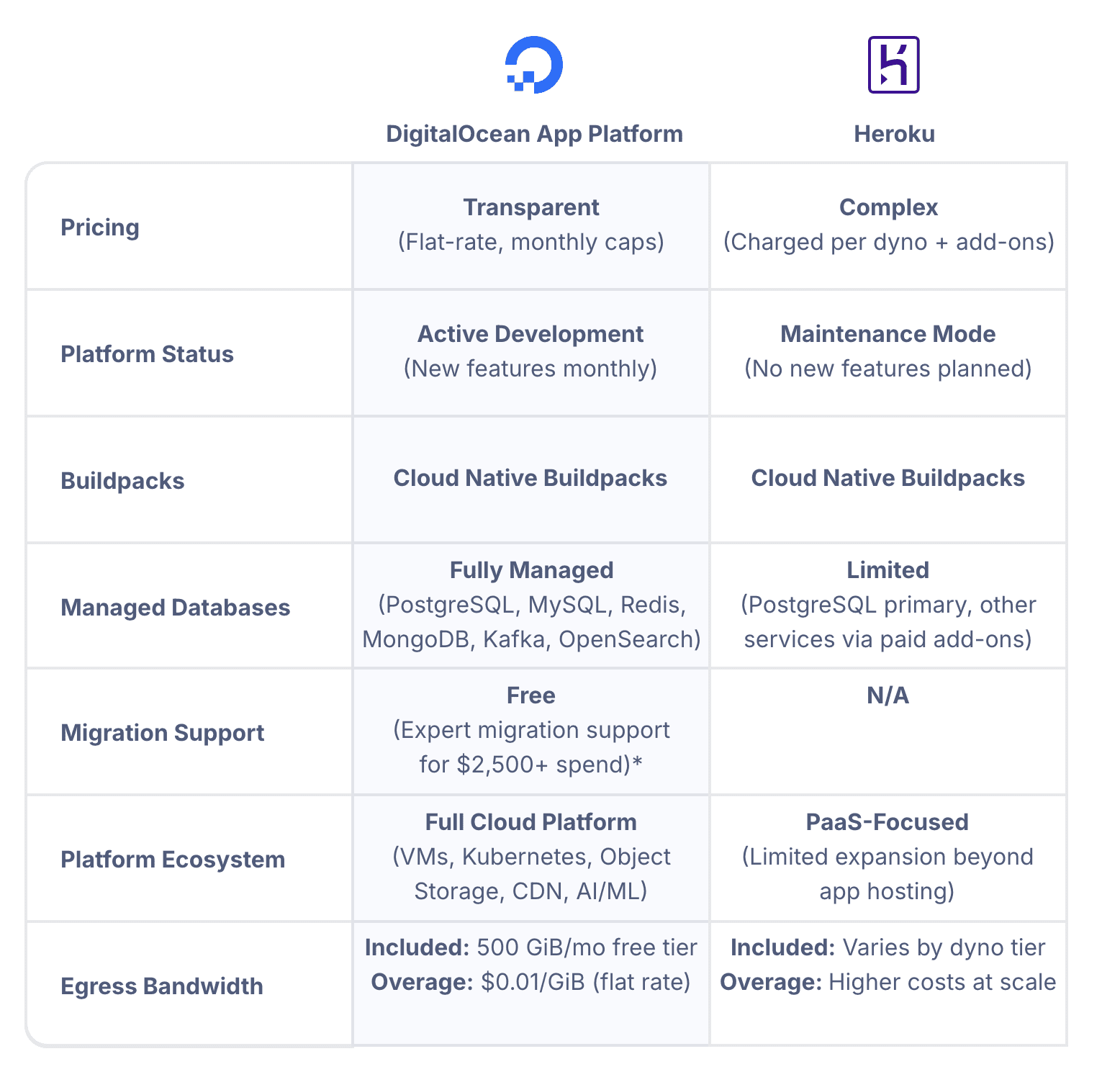
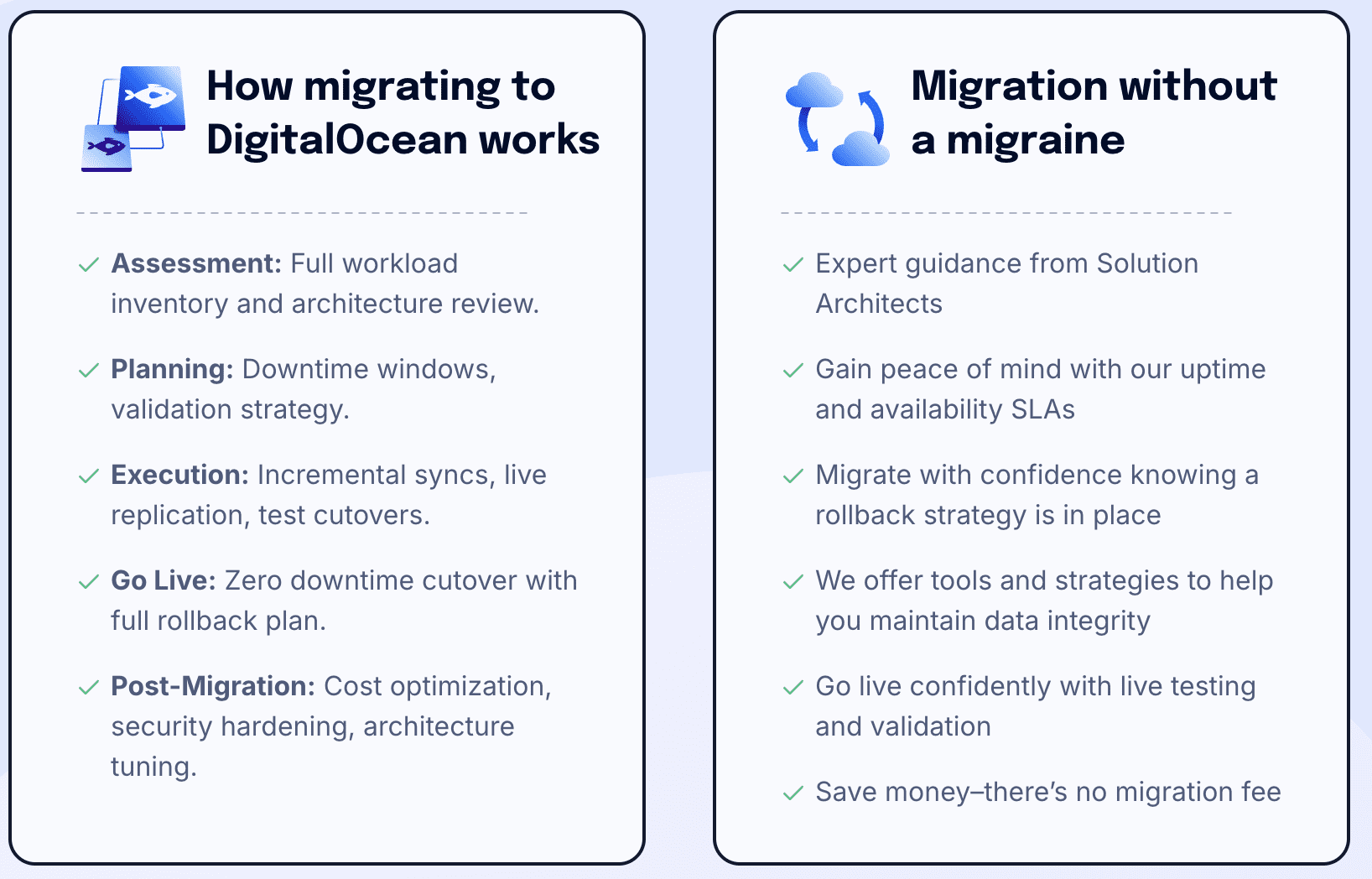
The consistent theme is momentum + portability. For this we like DigitalOcean.
Frequently Asked Questions About Heroku in 2026
Is Heroku shutting down?
No. It remains operational and supported.
Is Heroku still secure?
Yes. Security patches and compliance updates continue.
Should I migrate immediately?
Not necessarily. Existing apps can remain stable.
Is it wise to start a new SaaS on Heroku?
It depends. For short-term simplicity, possibly. For long-term infrastructure strategy, alternatives may offer more growth alignment.
What are the best Heroku alternatives?
Popular options include modern managed PaaS platforms and cloud-native container services that continue active development.
Final Thoughts
Heroku in 2026 is:
-
Stable
-
Supported
-
Mature
It is not:
-
Rapidly expanding
-
Aggressively innovating
-
Positioned as a strategic growth engine
For existing systems, stability may be enough.
For new builds, we prefer platforms aligned with forward momentum.
Infrastructure decisions compound.
We choose to build where innovation is still accelerating.